Webinar on Commemoration of Human Rights Day, 2021

Human rights are the cornerstone of a just and inclusive society, promoting equality, dignity, and freedom for all individuals. To honor and raise awareness about these fundamental rights, Youth Empowering Council (YECO), in partnership with SOGHA and Peace and Democracy Development Action (PEDDA), organized a virtual commemoration of Human Rights Day. The event brought together esteemed guest speakers, including Batuulo Ahmed Gabbale, Chair-Lady of the Somali Women Association, who shared their insights on human rights-related topics. The meeting, which was opened by YECO’s Executive Director, Mohamed Shariif, provided a platform for engaging discussions and reflection amongst the participants.

The virtual commemoration featured highly respected guest speakers who played a vital role in shedding light on various aspects of human rights. Batuulo Ahmed Gabbale, the Chair-Lady of the Somali Women Association, delivered a thought-provoking address that emphasized the importance of gender equality, women’s rights, and the empowerment of marginalized groups within society. Her inspiring words resonated with participants, sparking meaningful conversations on promoting and protecting human rights in Somalia.

The event fostered an interactive environment where participants actively engaged with the guest speakers. The discussions encompassed a wide range of human rights issues, including access to education, healthcare, freedom of expression, and the rights of vulnerable communities. Through these conversations, attendees were encouraged to share their experiences, perspectives, and innovative ideas for advancing human rights in their communities.

The commemoration drew to a close with closing remarks by Abdifitah Abdullahi from PEDDA. He expressed his gratitude to the guest speakers, participants, and the organizing partners for their unwavering commitment to promoting and safeguarding human rights. He emphasized the need for continued collaboration and collective action to address human rights challenges and create a more inclusive and equitable society.

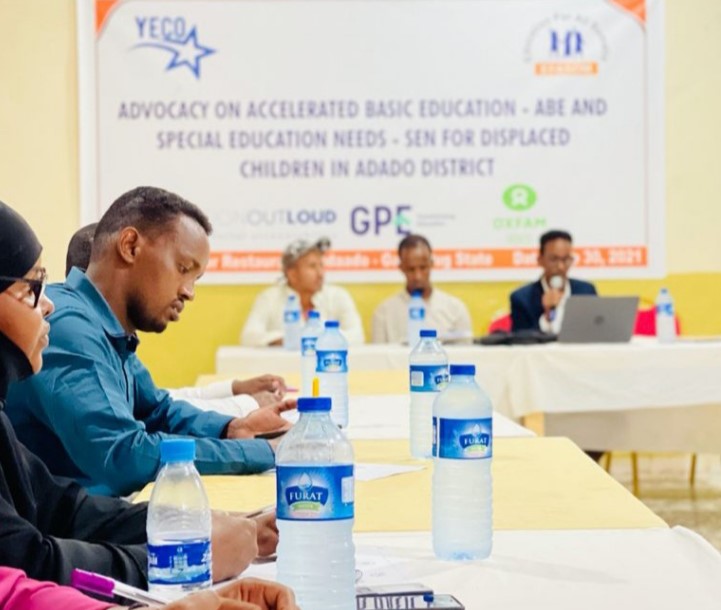
Advocacy for Accelerated Basic Education (ABE) and Special Education Needs (SENs) for Displaced Children in Cadaado District, Galmudug State

Access to quality education is crucial for the holistic development and future prospects of every child. Unfortunately, displaced children often face significant barriers to education due to their challenging circumstances. However, in Cadaado district, Galmudug State, a remarkable initiative took place to address this pressing issue. Youth Empowering Council (YECO), in collaboration with Education for All Somalia (EFASOM) and OXFAM Netherlands, supported by funds from the Global Partnership for Education (GPE) under the Education Outloud Project (EOL) Phase I, organized an advocacy meeting to prioritize Accelerated Basic Education (ABE) and Special Education Needs (SENs) for displaced children.

The meeting, held in Cadaado district, was opened by the district education officer (DEO) while the panelists and participants engaged in an in-depth discussion on ABE and SENs for displaced children. The event brought together key stakeholders, including education experts, community leaders, educators, parents, and representatives from local organizations. Their collective dedication and shared commitment to the cause set the stage for a productive and impactful dialogue.

During the meeting, the importance of ABE and SENs for displaced children was emphasized. Speakers highlighted the urgent need to provide these children with tailored educational opportunities that address their unique learning needs. The discussions revolved around innovative strategies, inclusive teaching methodologies, and the provision of adequate resources to create an enabling environment for their education.

The meeting concluded with remarks from YECO’s Executive Director, Mohamed Shariif, who expressed gratitude to all participants for their active engagement and valuable contributions. He emphasized the importance of continued collaboration among stakeholders to ensure the successful implementation of ABE and SENs programs in Cadaado district. The event served as a catalyst for future action, inspiring attendees to work together and advocate for policy changes, resource allocation, and community support to address the educational needs of displaced children.

Youth participation in politics: Challenges and opportunities

Background:

Somalia, situated in the Horn of Africa, has experienced political instability for the past three decades. The country faces a multitude of challenges that directly affect its youth population. These challenges include high levels of unemployment, insecurity, radicalization, forced irregular migration, inadequate access to quality education and vocational training, and limited healthcare services. Somalia has a predominantly young population, with approximately 70% of its people under the age of 30 and over 60% under the age of 25. Despite the significant youth demographic, young people of working age bear the brunt of a staggering unemployment rate estimated at 60%, which is one of the highest in the world.

Somali youth face immense pressure stemming from various issues, and unfortunately, this situation persists due to a lack of youth representation and involvement in politics at both the national and state levels. Political power in Somalia has historically been dominated by older individuals and those who possess financial stability. Consequently, opportunities for youth to actively participate in politics have been limited. The electoral process itself is also largely controlled and preserved for older individuals. Although there have been some openings for youth involvement in the political process, the government has yet to fully support youth participation in elections and the promotion of democratic values.

The need for greater youth engagement and inclusion in politics is crucial for Somalia’s development and stability. By empowering and involving young people in decision-making processes, there is a higher likelihood of addressing the challenges they face and creating opportunities for positive change. Efforts to bridge the gap between the youth and political spheres, as well as to ensure their active participation in elections and democratic processes, are essential for building a more inclusive and prosperous future for Somalia.

“A picture depicts youths who are engaged in a campaign.”

Major challenges that youth can face when they decided to participate politics and elections process include:

Lack of support: The youth have not received any support from the national government, states and other organizations

Unemployment: The country has high rates of unemployment which make youth have less powers to get chances to participate in election and political processes

Lack of organization: Somali youth across the board lack necessary organizations that could mobilize youth energy and direct it for the common good. This would include putting pressure on the administrations at different levels to design and implement policies that benefit youth. Nevertheless, many of the organizations are shoddy or dormant that have no discernable effect on how politics works and how policies are made.

Divisive and clannish mindset: seeing and evaluating everything through the prism of clan can deprive youth from standing up for the advocacy on the issues that affect them and holding authorities accountable.

Indirect elections: Back-to-back indirect elections are major limitation to the youth involvement in the political process. Due to the rather narrow political space, many of the youth end up being campaigners for other politicians. This might be the only option since politics is a reserve for the financially-able and well-connected. If there were universal suffrage elections, politically ambitious youth would have had higher prospects for winning seats since they are often closer to the local communities and lived realities on the ground.

Opportunities:

Above, we listed a number of challenges that youth can face when they decide to participate in politics and elections. However, there are also several opportunities that can help youth engage in politics in Somalia. The following are some of these opportunities:

Early involvement in political parties: The Somali National Independent Electoral Commission (NIEC) has registered a number of political parties that are ready to compete for leadership in the nation. These political parties offer opportunities for youth to join them and work together towards achieving political goals. By becoming members of political parties, youth can actively participate in politics in Somalia.

Building youth alliances: As the Somali proverb says, “Gacmo wadajir ayey wax ku gooyaan” (Unity is strength), youth need to establish alliances to enhance their political participation. If you fail to achieve a certain action, try again with the support of your friends or colleagues. Currently, Somalia lacks effective youth alliances with a strong vision for political participation. Therefore, Somali youth need to form effective alliances that can protect them and respond to the pressures exerted by older individuals who aspire to be politicians repeatedly.

Becoming influential young politicians: Aspiring to be a politician in Somalia is not an easy task; it requires a strong vision and careful planning. Becoming an influential young politician can significantly contribute to your political participation in Somalia and help you achieve your political goals. By combining your potential with a high level of influence, your prospects for political engagement will be more positive.